



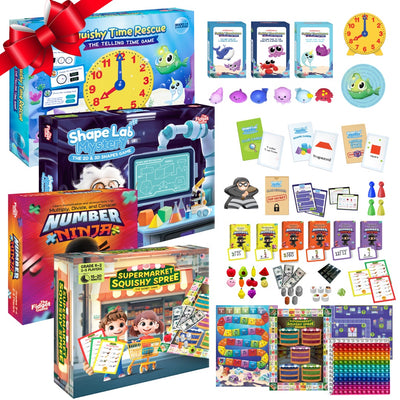
1 Shapes Chart
Educator CreatedDesigned by teachers
30-day returnshassle-free
Secure paymentsSSL encrypted
Ships in 3 daysfrom the US
Shape Lab Mystery
Shape Lab Mystery
Regular price
$29.99
Sale price
$29.99
Regular price
$34.99
Unit price
per
What's Inside The Box
Skills Covered After 30 Days
- Build geometry skills by recognizing 2D and 3D shapes and their attributes
- Strengthen understanding of sides, vertices, edges, faces, and lines of symmetry
- Practice describing and comparing shapes with precise math vocabulary
- Encourage problem-solving and critical thinking with engaging shape challenges
Key Features
- Ages 4+
- 2-4 Players (or 1-on-1 fun)
- Quick & Easy Play (10 min)
Educational Standards
Common Core
- CCSS.Math.Content.K.G.A.2 Correctly name shapes regardless of their orientations or overall size.
- CCSS.Math.Content.K.G.A.3 Identify shapes as two-dimensional (lying in a plane, "flat") or three-dimensional ("solid").
- CCSS.Math.Content.K.G.B.4 Analyze and compare two- and three-dimensional shapes, in different sizes and orientations, using informal language to describe their similarities, differences, parts (e.g., number of sides and vertices/"corners") and other attributes (e.g., having sides of equal length).
- CCSS.Math.Content.1.G.A.1 Distinguish between defining attributes (e.g., triangles are closed and three-sided) versus non-defining attributes (e.g., color, orientation, overall size); build and draw shapes to possess defining attributes.
- CCSS.Math.Content.2.G.A.1 Recognize and draw shapes having specified attributes, such as a given number of angles or a given number of equal faces.1 Identify triangles, quadrilaterals, pentagons, hexagons, and cubes.
TEKS
- K.6A: Identify two-dimensional shapes, including circles, triangles, rectangles, and squares as special rectangles.
- K.6B: Identify three-dimensional solids, including cylinders, cones, spheres, and cubes, in the real world.
- K.6D: Identify attributes of two-dimensional shapes using informal and formal geometric language interchangeably.
- K.6E: Classify and sort a variety of regular and irregular two- and three-dimensional figures regardless of orientation or size.
- 1.6A: Classify and sort regular and irregular two-dimensional shapes based on attributes using informal geometric language.
- 1.6B: Distinguish between attributes that define a two-dimensional or three-dimensional figure and attributes that do not define the shape.
- 1.6D: Identify two-dimensional shapes, including circles, triangles, rectangles, and squares, as special rectangles, rhombuses, and hexagons and describe their attributes using formal geometric language.
- 1.6E: Identify three-dimensional solids, including spheres, cones, cylinders, rectangular prisms (including cubes), and triangular prisms, and describe their attributes using formal geometric language.
- 2.8D: Compose two-dimensional shapes and three-dimensional solids with given properties or attributes.
B.E.S.T.
- MA.K.GR.1.1 Identify two- and three-dimensional figures regardless of their size or orientation. Figures are limited to circles, triangles, rectangles, squares, spheres, cubes, cones and cylinders.
- MA.K.GR.1.2 Compare two-dimensional figures based on their similarities, differences and positions. Sort two-dimensional figures based on their similarities and differences. Figures are limited to circles, triangles, rectangles and squares.
- MA.K.GR.1.3 Compare three-dimensional figures based on their similarities, differences and positions. Sort three-dimensional figures based on their similarities and differences. Figures are limited to spheres, cubes, cones and cylinders.
- MA.K.GR.1.4 Find real-world objects that can be modeled by a given two- or three-dimensional figure. Figures are limited to circles, triangles, rectangles, squares, spheres, cubes, cones and cylinders.
- MA.1.GR.1.1 Identify, compare and sort two- and three-dimensional figures based on their defining attributes. Figures are limited to circles, semi-circles, triangles, rectangles, squares, trapezoids, hexagons, spheres, cubes, rectangular prisms, cones and cylinders.
- MA.1.GR.1.4 Given a real-world object, identify parts that are modeled by two- and three-dimensional figures. Figures are limited to semi-circles, triangles, rectangles, squares and hexagons, spheres, cubes, rectangular prisms, cones and cylinders.
- MA.2.GR.1.2 Categorize two-dimensional figures based on the number and length of sides, number of vertices, whether they are closed or not and whether the edges are curved or straight.
Ontario
- K- OE17 describe, sort, classify, build, and compare two-dimensional shapes and three-dimensional figures, and describe the location and movement of objects through investigation
- Grade 1- E1.1 sort three-dimensional objects and two-dimensional shapes according to one attribute at a time, and identify the sorting rule being used
- Grade 2- E1.1 sort and identify two-dimensional shapes by comparing number of sides, side lengths, angles, and number of lines of symmetry
- Grade 2- E1.3 identify congruent lengths and angles in two-dimensional shapes by mentally and physically matching them, and determine if the shapes are congruent
- Grade 3- E1.1 sort, construct, and identify cubes, prisms, pyramids, cylinders, and cones by comparing their faces, edges, vertices, and angles
British Columbia
- K- number concepts to 10, single attributes of 2D shapes and 3D objects
- Grade 1- comparison of 2D shapes and 3D objects
- Grade 2- multiple attributes of 2D shapes and 3D objects
- Grade 3- construction of 3D objects
Alberta
- K- Children investigate shape.
- Grade 1- Students interpret shape in two and three dimensions.
- Grade 2- Students analyze and explain geometric attributes of shape.
- Grade 3- Students relate geometric properties to shape.
Manitoba
- K- Describe the characteristics of 3-D objects and 2-D shapes, and analyze the relationships among them.
- 1.SS.2. Sort 3-D objects and 2-D shapes using one attribute, and explain the sorting rule.
- 2.SS.6. Sort 2-D shapes and 3-D objects using two attributes, and explain the sorting rule.
- 2.SS.7. Describe, compare, and construct 3-D objects
- 2.SS.8. Describe, compare, and construct 2-D shapes
- 3.SS.6. Describe 3-D objects according to the shape of the faces and the number of edges and vertices.
- 4.SS.6. Demonstrate an understanding of line symmetry
New Brunswick
- K- Sort familiar concrete 3D objects using a single attribute
- 1.SS2 : Sort 3-D objects and 2-D shapes using one attribute, and explain the sorting rule.
- 2.SS6 Sort 2-D shapes and 3-D objects using two attributes, and explain the sorting rule.
- 2.SS.7. Describe, compare, and construct 3-D objects
Newfoundland & Labrador
- K- 3.KSS2 Sort 3-D objects using a single attribute and explain the sorting rule.
- 1.SS2 : Sort 3-D objects and 2-D shapes using one attribute, and explain the sorting rule.
- 2.SS6 Sort 2-D shapes and 3-D objects using two attributes, and explain the sorting rule.
- 2.SS.7. Describe, compare, and construct 3-D objects
Nova Scotia
- K- 3-D Objects and 2-D Shapes - Students will be describe the characteristics of 3-D objects and 2-D shapes and analyze the relationships among them.
- 1.SS2 : Sort 3-D objects and 2-D shapes using one attribute, and explain the sorting rule.
- 2.SS6 Sort 2-D shapes and 3-D objects using two attributes, and explain the sorting rule.
- 2.SS.7. Describe, compare, and construct 3-D objects
Prince Edward Island
- K- SS.2 Describe the characteristics of 3-D objects and 2-D shapes, and analyze the relationships among them.
- 1.SS2 – Sort, compare, and construct 3D objects and 2D shapes
- 2.SS5 – Describe, compare and construct 3D objects,
- 2.SS6 – Describe, compare and construct 2D shapes
Saskatchewan
- K- SSK.2 Sort 3-D objects using a single attribute.
- SS1.2 Sort 3-D objects and 2-D shapes using one attribute, and explain the sorting rule.
- SS2.3 Describe, compare, and construct 3-D objects
- SS2.4 Describe, compare, and construct 2-D shapes
- SS3.4 Demonstrate understanding of 3-D objects by analyzing characteristics including faces, edges, and vertices.
- SS3.5 Demonstrate understanding of 2-D shapes (regular and irregular)
- SS4.4 Demonstrate an understanding of line symmetry
Our games are used in 50,000+ classroomsSpecial discounts for school districts and homeschoolers.
Get a Quote



Skills Built
What skills does Shape Lab Mystery build?
Geometry
Shapes, space, and patterns
30-Day Money Back Guarantee
Watch How Shape Lab Mystery Works


* Results based on internal study with regular users. Individual results may vary.

You ask, we answer!
What is the return policy?
We offer a 30-day return policy for eligible items.