


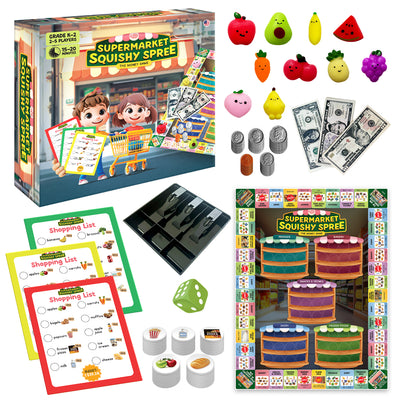
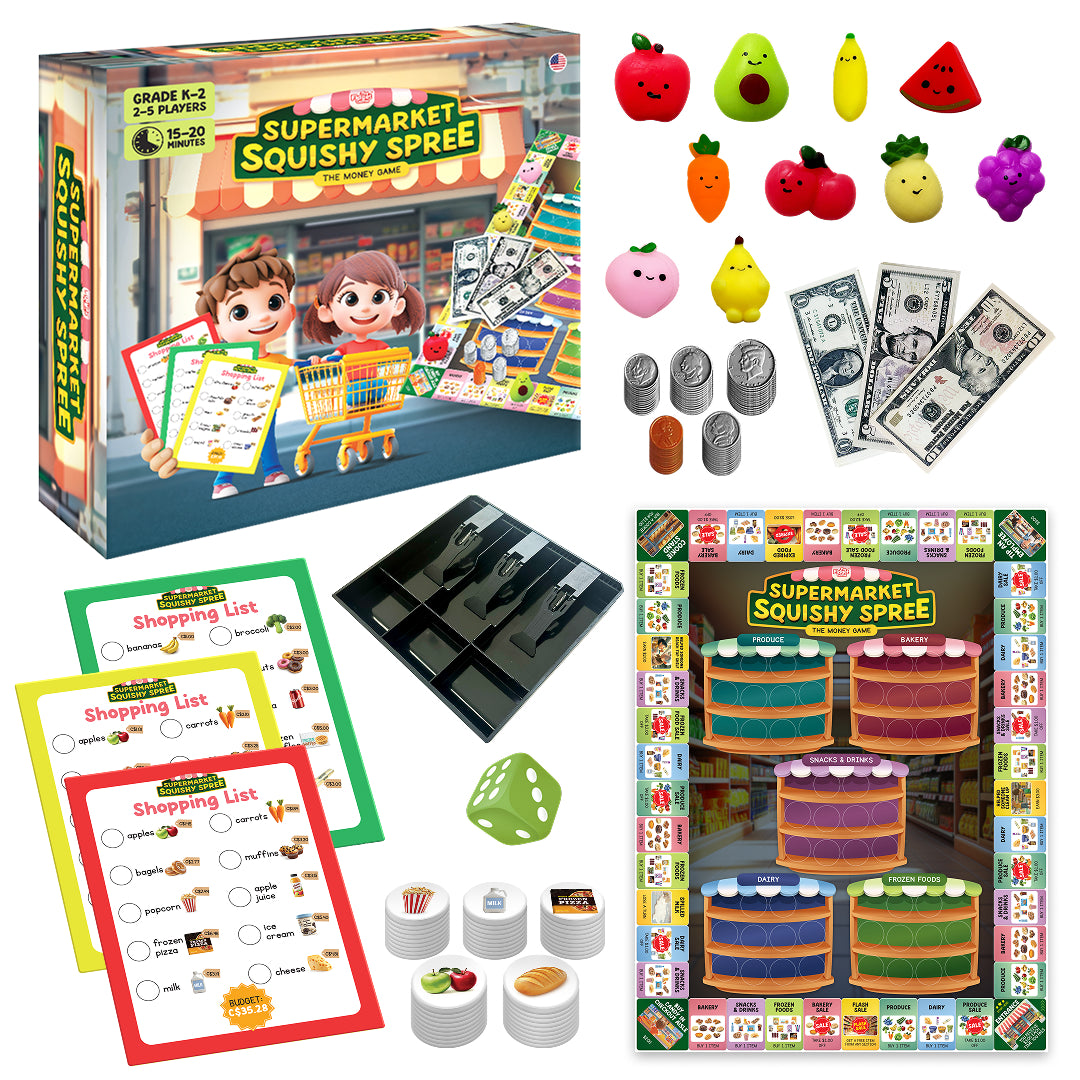
10 Shopping Lists
Educator CreatedDesigned by teachers
30-day returnshassle-free
Secure paymentsSSL encrypted
Ships in 3 daysfrom the US
Supermarket Squishy Spree
Supermarket Squishy Spree
Regular price
$39.99
Sale price
$39.99
Regular price
$49.99
Unit price
per
What's Inside The Box
Skills Covered After 30 Days
- Build money skills by counting dollars and coins
- Strengthen understanding of coin values and combinations
- Practice budgeting and making smart spending choices
- Boost real-world math confidence through hands-on play
- Encourage problem-solving and strategic thinking
Key Features
- Ages 4+
- 2-6 Players (or 1-on-1 fun)
- Quick & Easy Play (10 min)
Educational Standards
Common Core
- CCSS.Math.Content.2.MD.C.8 Solve word problems involving dollar bills, quarters, dimes, nickels, and pennies, using $ and ¢ symbols appropriately.
TEKS
- K.4A: Identify U.S. coins by name, including pennies, nickels, dimes, and quarters.
- 1.4A: Identify U.S. coins, including pennies, nickels, dimes, and quarters, by value and describe the relationships among them.
- 1.4B: Write a number with the cent symbol to describe the value of a coin.
- 1.4C: Use relationships to count by twos, fives, and tens to determine the value of a collection of pennies, nickels, and/or dimes.
- 2.5A: Determine the value of a collection of coins up to one dollar.
- 2.5B: Use the cent symbol, dollar sign, and the decimal point to name the value of a collection of coins.
B.E.S.T.
- MA.1.M.2.2 Identify pennies, nickels, dimes and quarters, and express their values using the ¢ symbol. State how many of each coin equal a dollar.
- MA.1.M.2.3 Find the value of combinations of pennies, nickels and dimes up to one dollar, and the value of combinations of one, five and ten dollar bills up to $100. Use the ¢ and $ symbols appropriately.
- MA.2.M.2.2 Solve one- and two-step addition and subtraction real-world problems involving either dollar bills within $100 or coins within 100¢ using $ and ¢ symbols appropriately.
Ontario
- Grade 1- F1.1 identify the various Canadian coins up to 50¢ and coins and bills up to $50, and compare their values
- Grade 2- F1.1 identify different ways of representing the same amount of money up to Canadian 200¢ using various combinations of coins, and up to $200 using various combinations of $1 and $2 coins and $5, $10, $20, $50, and $100 bills
- Grade 3- F1.1 estimate and calculate the change required for various simple cash transactions involving whole-dollar amounts and amounts of less than one dollar
British Columbia
- Grade 1- financial literacy — values of coins, and monetary exchanges
- Grade 2- financial literacy — coin combinations to 100 cents, and spending and saving
- Grade 3- financial literacy — fluency with coins and bills to 100 dollars, and earning and payment
Alberta
- Grade 2- Determine the value of a collection of coins or bills of the same denomination by skip counting.
- Grade 3- Count and represent the value of a collection of loonies, toonies, and bills as dollars.
- Grade 4- Express a monetary value in cents as a monetary value in dollars using decimal notation.
Manitoba
- 1.N1: Say the number sequence, 0 to 100
- 1.N10: Describe and use mental mathematics strategies (memorization not intended)
- 2.N4: Represent and describe numbers to 100, concretely, pictorially and symbolically.
- 2.N1: Say the number sequence, 0 to 100
- 2.N10: Describe and use mental mathematics strategies (memorization not intended)
New Brunswick
- N1: Say the number sequence, 0 to 100
- N4: Represent and describe numbers to 100, concretely, pictorially and symbolically.
- N10: Describe and use mental mathematics strategies (memorization not intended)
Newfoundland & Labrador
- 1N1: Say the number sequence, 0 to 100
- 1N9. Describe and use mental mathematics strategies for basic addition facts and related subtraction facts to 18.
- 2N1 Say the number sequence from 0 to 100
- 2N4 Represent and describe numbers to 100, concretely, pictorially and symbolically.
- 2N9 Demonstrate an understanding of addition (limited to one- and two-digit numerals ) with answers to 100 and the corresponding subtraction
- 3N1.5 Determine the value of a given set of coins (nickels, dimes, quarters, loonies) by using skip counting.
- 4N10.4 Express a given pictorial or concrete representation as a fraction or decimal.
Nova Scotia
- Grade 1- N01 Students will be expected to say the number sequence
- Grade 1- N03 Students will be expected to demonstrate an understanding of counting to 20
- Grade 1- N04 Students will be expected to represent and partition numbers to 20.
- Grade 1- N10 Students will be expected to use and describe strategies to determine sums and differences using manipulatives and visual aids.
- Grade 2- N01 Students will be expected to say the number sequence
- Grade 2- N04 Students will be expected to represent and partition numbers to 100.
- Grade 2- N10 Students will be expected to apply mental mathematics strategies to quickly recall basic addition facts to 18 and determine related subtraction facts.
- Grade 3- N01.07 Determine the value of a given set of coins (nickels, dimes, quarters, and loonies) by using skip counting.
Prince Edward Island
- 1.N1 Say the number sequence, 0 to 100
- 1.N9 Describe and use mental mathematics strategies for basic addition facts and related subtraction facts to 18.
- 2.N1 Say the number sequence from 0 to 100
- 2.N4 Represent and describe numbers to 100, concretely, pictorially and symbolically.
- 3.N1 Say the number sequence forward and backward from 0 to 1000
Saskatchewan
- N1.1 Say the number sequence, 0 to 100
- N1.3 Demonstrate an understanding of counting
- N1.4 Represent and describe whole numbers to 20 concretely, pictorially, and symbolically.
- N1.10 Describe and use mental mathematics strategies (memorization not intended
- N2.1 Demonstrate understanding of whole numbers to 100 (concretely, pictorially, physically, orally, in writing, and symbolically)
- N3.1 Demonstrate understanding of whole numbers to 1000 (concretely, pictorially, physically, orally, in writing, and symbolically)
Our games are used in 50,000+ classroomsSpecial discounts for school districts and homeschoolers.
Get a Quote


Families Who Have Already Made Math Fun
4.88
Skills Built
What skills does Supermarket Squishy Spree build?
Money
Counting coins and bills to find total values and make change
30-Day Money Back Guarantee
How to Play
How to play Supermarket Squishy Spree

1
Roll the die and move your squishy pawn.
2
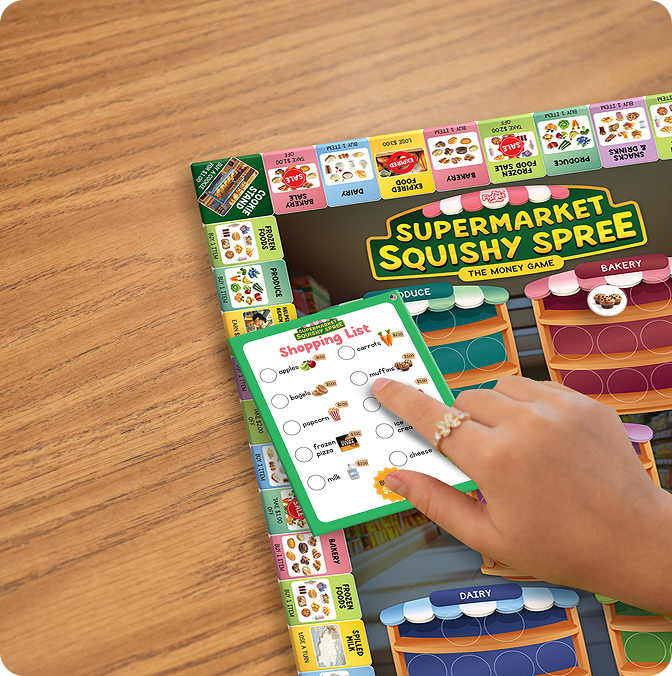
Shop for the items on your list.

3
Complete your shopping list and stay on budget to win!
Watch How Supermarket Squishy Spree Works


* Results based on internal study with regular users. Individual results may vary.
You ask, we answer!
What is the return policy?
We offer a 30-day return policy for eligible items.