


3 Card packs (249 cards in total)
Educator CreatedDesigned by teachers
30-day returnshassle-free
Secure paymentsSSL encrypted
Ships in 3 daysfrom the US
The Vocabulary Game
The Vocabulary Game
Regular price
$29.99
Sale price
$29.99
Regular price
$34.99
Unit price
per
Choose Your Option
 The Vocabulary Game
$29.99$34.99Save $5.00
The Vocabulary Game
$29.99$34.99Save $5.00
 Grade 3-5 Shark Tank Bundle
Most Popular!Full Grade 3-5 Bundle - 5 Games Included + 1 Expansion Card Packs
$150.46$214.94Save $64.48
Grade 3-5 Shark Tank Bundle
Most Popular!Full Grade 3-5 Bundle - 5 Games Included + 1 Expansion Card Packs
$150.46$214.94Save $64.48
 Grade 3-5 Classroom Bundle
Best Value!Full Grade 3-5 Bundle - 5 Games Included + 1 Expansion Card Pack + Extra Mats
$137.96$229.93Save $91.97
Grade 3-5 Classroom Bundle
Best Value!Full Grade 3-5 Bundle - 5 Games Included + 1 Expansion Card Pack + Extra Mats
$137.96$229.93Save $91.97
What's Inside The Box
Skills Covered After 30 Days
- Increases Tier 2 Vocabulary
- Strengthens Communication
- Improves Reading Comprehension
- Boosts Academic Performance
- Builds Confidence
Key Features
- Ages 7+
- 2-4 Players (or 1-on-1 fun)
- Quick & Easy Play (10 min)
Educational Standards
Common core
- CCSS.ELA-LITERACY.L.4.4 Determine or clarify the meaning of unknown and multiple-meaning words and phrases based on grade 4 reading and content, choosing flexibly from a range of strategies.
- CCSS.ELA-LITERACY.L.5.4 Determine or clarify the meaning of unknown and multiple-meaning words and phrases based on grade 5 reading and content, choosing flexibly from a range of strategies.
- CCSS.ELA-LITERACY.L.6.4 Determine or clarify the meaning of unknown and multiple-meaning words and phrases based on grade 6 reading and content, choosing flexibly from a range of strategies.
TEKS
- 4.3A: Use print or digital resources to determine meaning, syllabication, and pronunciation.
- 5.3A: Use print or digital resources to determine meaning, syllabication, pronunciation, and word origin.
- 6.2A: Use print or digital resources to determine the meaning, syllabication, pronunciation, word origin, and part of speech.
B.E.S.T
- ELA.4.V.1.1Use grade-level academic vocabulary appropriately in speaking and writing.
- ELA.5.V.1.1 Use grade-level academic vocabulary appropriately in speaking and writing.
- ELA.6.V.1.1 Integrate academic vocabulary appropriate to grade level in speaking and writing.
Ontario
- Grade 4- B2.2 demonstrate an understanding of a variety of words, acquire and use explicitly taught vocabulary in various contexts, including other subject areas, and use morphological knowledge to analyze and understand new words in context
- Grade 5- B2.2 demonstrate an understanding of a variety of words, acquire and use explicitly taught vocabulary in various contexts, including other subject areas, and use generalized morphological knowledge to analyze and understand new words in context
- Grade 6- B2.2 demonstrate an understanding of a variety of words, acquire and use explicitly taught vocabulary in various contexts, including other subject areas, and use generalized morphological knowledge to analyze and understand new words in context
BC
- Grade 4- Strategies and processes: reading strategies
- Grade 5- Strategies and processes: reading strategies
- Grade 6- Strategies and processes: reading strategies
Alberta
- Grade 4: Students expand vocabulary and analyze morphemes to communicate in multiple contexts.
- Grade 5: Students analyze how knowledge of vocabulary supports meaning and use of language.
- Grade 6: Students evaluate how vocabulary enhances communication and provides clarity.
Manitoba
- Grade 4- Be aware of and articulate the ways that one engages with text.
- Grade 5- Be aware of and articulate the ways that one engages with text.
- Grade 6- Be aware of and articulate the ways that one engages with text.
New Brunswick
- Grade 4- Use a range of vocabulary when communicating.
- Grade 5- Use a range of vocabulary when communicating.
- Grade 6- Recognize how different strategies are used to determine the meanings of words.
Newfoundland & Labrador
- Grade 4- Use strategies to make sense of texts
- Grade 5- Use pictures and illustrations, word structures, and text features to locate topics and obtain or verify their understanding of information
- Grade 6- Use and integrate the pragmatic, semantic, syntactic and graphophonic cueing systems (e.g., context clues; structural analysis to identify roots, prefixes and suffixes; text structures) and a variety of strategies to construct meaning.
Nova Scotia
- Grade 4- Use and integrate the pragmatic, semantic, syntactic, and graphophonic cueing systems (including context clues; word order; suffixes, compound words, contractions, and singular and plural words) and a variety of strategies to construct meaning
- Grade 5- Use and integrate the pragmatic, semantic, syntactic, and graphophonic cueing systems (including context clues; word order; structural analysis to identify roots, prefixes, and suffixes) and a variety of strategies to construct meaning; use a dictionary to determine word meaning in context
- Grade 6- Use and integrate the various cueing systems and a variety of strategies with increasing independence to construct meaning
Prince Edward Island
- Grade 4- Use and integrate, with support, the various cueing systems (pragmatic, semantic, syntactic, and graphophonic) and a range of strategies to construct meaning
- Grade 5- Use and integrate the pragmatic, semantic, syntactic, and graphophonic cueing systems (including context clues; word order; structural analysis to identify roots, prefixes, and suffixes) and a variety of strategies to construct meaning; use a dictionary to determine word meaning in context
- Grade 6- Use and integrate the various cueing systems and a variety of strategies with increasing independence to construct meaning
Saskatchewan
- Grade 4- CC4.2 Create a variety of clear representations that communicate straightforward ideas and information relevant to the topic and purpose, including short, illustrated reports, dramatizations, posters, and other visuals such as displays and drawings.
- Grade 5- CC5.2 Demonstrate a variety of ways to communicate understanding and response including illustrated reports, dramatizations, posters, timelines, multimedia presentations, and summary charts.
- Grade 6- CC6.3 Use pragmatic (e.g., function and purpose), textual (e.g., paragraphs), syntactic (e.g., complete sentences with appropriate subordination and modification), semantic/lexical/morphological (e.g., figurative words), graphophonic (e.g., spelling strategies), and other cues (e.g., appropriate volume and intonation) to construct and to communicate meaning
Our games are used in 50,000+ classroomsSpecial discounts for school districts and homeschoolers.
Get a Quote


Families Who Have Already Learned to Read
4.9
Skills Built
What skills does The Vocabulary Game build?
Fluency
Reading smoothly and accurately
Comprehension
Understanding what you read
Vocabulary
Learning and using new words
30-Day Money Back Guarantee
How to Play
How to play The Vocabulary Game
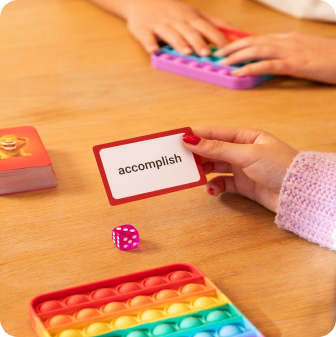
1
Choose a card pack
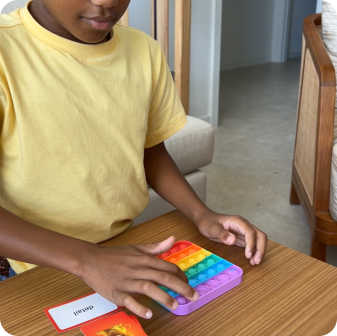
2
Define or use the word in a sentence
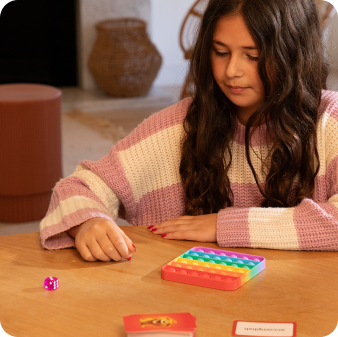
3
Roll the die
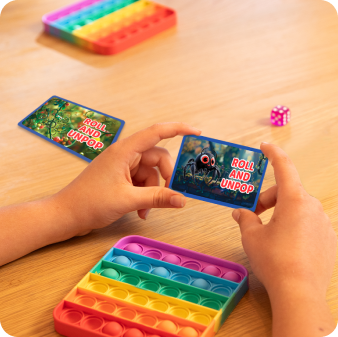
4
Spider card = Roll and unpop bubbles / Jungle Card = Roll and Pop bubbles

5
Pop bubbles to win!
Watch How The Vocabulary Game Works


* Results based on internal study with regular users. Individual results may vary.
You ask, we answer!
What is the return policy?
We offer a 30-day return policy for eligible items.