


Kindergarten 18 Clue Cards
Educator CreatedDesigned by teachers
30-day returnshassle-free
Secure paymentsSSL encrypted
Ships in 3 daysfrom the US
Pirate Island
Pirate Island
Regular price
$29.99
Sale price
$29.99
Regular price
$34.99
Unit price
per
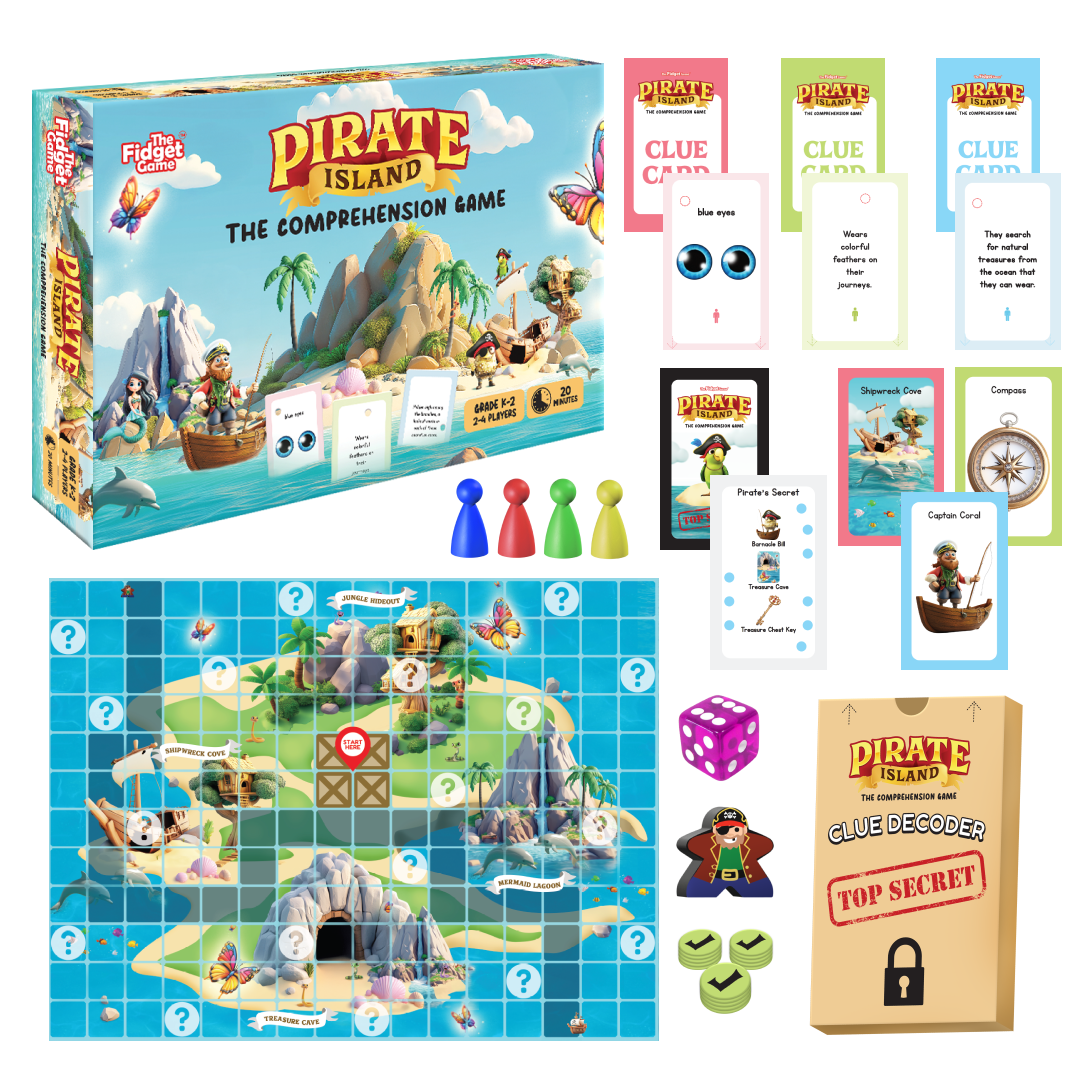
What's Inside The Box
Skills Covered After 30 Days
- Identify and describe story characters, settings, and major events
- Develop the ability to sequence and retell events from a story
- Strengthen comprehension skills through questioning and discussion
- Practice making inferences using text clues and background knowledge
- Build critical thinking by connecting details to story's meaning
Key Features
- Ages 4+
- 2-4 Players (or 1-on-1 fun)
- Quick & Easy Play (10 min)
Educational Standards
BEST
- ELA.K.R.1.1 Describe the main character(s), setting, and important events in a story.
- ELA.1.R.1.1 Identify and describe the main story elements in a story.
- ELA.2.R.1.1 Identify plot structure and describe main story elements in a literary text.
- ELA.K12.EE.3.1 Make inferences to support comprehension.
Common Core
- CCSS.ELA-LITERACY.RL.K.3 With prompting and support, identify characters, settings, and major events in a story.
- CCSS.ELA-LITERACY.RL.1.3 Describe characters, settings, and major events in a story, using key details.
- CCSS.ELA-LITERACY.RL.1.2 Retell stories, including key details, and demonstrate understanding of their central message or lesson.
- CCSS.ELA-LITERACY.RL.2.1 Ask and answer such questions as who, what, where, when, why, and how to demonstrate understanding of key details in a text.
- CCSS.ELA-LITERACY.RL.2.3 Describe how characters in a story respond to major events and challenges.
- CCSS.ELA-LITERACY.CCRA.R.1 Read closely to determine what the text says explicitly and to make logical inferences from it; cite specific textual evidence when writing or speaking to support conclusions drawn from the text.
TEKS
- K.7B: Identify and describe the main character(s). K.7D: Describe the setting. K.7C: Describe the elements of plot development, including the main events, the problem, and the resolution for texts read aloud with adult assistance.
- 1.8B: Describe the main character(s) and the reason(s) for their actions. 1.8C: Describe plot elements, including the main events, the problem, and the resolution, for texts read aloud and independently. 1.8D: Describe the setting.
- 2.6F: Make inferences and use evidence to support understanding. 2.8B: Describe the main character's (characters') internal and external traits. 2.8C: Describe and understand plot elements, including the main events, the conflict, and the resolution, for texts read aloud and independently.
Ontario
- Grade 3-C1.1 read and comprehend various texts, using knowledge of words, grammar, cohesive ties, sentence structures, and background knowledge
- Grade 3- C1.3 identify some text patterns, such as order of importance and cause and effect, and text features, such as headings and an index, associated with various text forms, and explain how they help readers, listeners, and viewers understand the meaning
- Grade 3- C2.6 identify the main idea in a simple text, and relate important details in sequence
- Grade 3- C3.2 make inferences using stated and implied information and ideas to understand texts
- Grade 4- C1.1 read and comprehend various texts, using knowledge of words, grammar, cohesive ties, sentence structures, and background knowledge
- Grade 4- C2.6 summarize the main idea of a text and the supporting details in sequence, and draw a simple conclusion
- Grade 4- C3.2 make local and global inferences, using explicit and implicit evidence, to extend their understanding of various texts
- Grade 5- C1.1 read and comprehend various texts, using knowledge of words, grammar, cohesive ties, sentence structures, and background knowledge
- Grade 5- C2.6 summarize the main idea of a text and the supporting details in sequence, and draw a well-supported conclusion
- Grade 5- C3.2 make local and global inferences, using explicit and implicit evidence, to extend their understanding of various texts
BC
- Grade 3- Explain the role that story plays in personal, family, and community identity
- Grade 3- Recognize the structure and elements of story
- Grade 3- Story/text: elements of story
- Grade 3- Strategies and processes: reading strategies
- Grade 4- Use a variety of comprehension strategies before, during, and after reading, listening, or viewing to deepen understanding of text
- Grade 4- Story/text: literary elements
- Grade 4- Strategies and processes: reading strategies
- Grade 5- Use a variety of comprehension strategies before, during, and after reading, listening, or viewing to guide inquiry and deepen understanding of text
- Grade 5- Strategies and processes: reading strategies
Alberta
- Grade 3- Students analyze text and make connections to personal experiences to support meaning.
- Grade 4- Students investigate strategies and connections that support text comprehension.
- Grade 5- Students analyze information, contexts, and perspectives using a variety of comprehension strategies.
Manitoba
- Grade 3- Select from and use a variety of strategies.
- Grade 3- Be aware of and articulate the ways that one engages with text.
- Grade 4- Select from and use a variety of strategies.
- Grade 4- Be aware of and articulate the ways that one engages with text.
- Grade 5- Select from and use a variety of strategies.
- Grade 5- Be aware of and articulate the ways that one engages with text.
New Brunswick
- Grade 3- Construct meaning from printed text when reading independently.
- Grade 4- Construct meaning from printed text when reading independently.
- Grade 5- Construct meaning from printed text when reading independently.
Newfoundland & Labrador
- Grade 3- GCO 4: Students will be expected to select, read, and view with understanding a range of literature, information, media, and visual texts. 18.0 use strategies to make sense of texts
- Grade 4- GCO 4: Students will be expected to select, read, and view with understanding a range of literature, information, media, and visual texts. 4.4 use strategies to make sense of texts
- Grade 5- GCO 4: Students will be expected to select, read, and view with understanding a range of literature, information, media, and visual texts. 4.6 use a variety of comprehension strategies
Nova Scotia
- Grade 3- Learners will demonstrate a variety of ways to comprehend and select from a range of culturally diverse texts.
- Grade 4- SCO 4.2 -read widely and experience a variety of children’s literature with an emphasis in genre and authors
- Grade 5- SCO 4.2 -read widely and experience a variety of children’s literature with an emphasis in genre and authors
Prince Edward Island
- Grade 3- Students will be expected to select, read, and view with understanding a range of literature, information, media, and visual texts.
- Grade 4- Students will be expected to select, read, and view with understanding a range of literature, information, media, and visual texts.
- Grade 5- Students will be expected to select, read, and view with understanding a range of literature, information, media, and visual texts.
Saskatchewan
- Grade 3- CR3.4 Read fluently and demonstrate comprehension of grade-appropriate fiction, script, poetry, and non-fiction from various cultures (including First Nations and Métis) and countries (including Canada) and explain reactions and connections to texts read.
- Grade 4- CR4.4 Read for various purposes and demonstrate comprehension of grade-appropriate fiction (including stories and novels), scripts, poetry, and non-fiction (including magazines, reports, instructions, and procedures) from various cultures including First Nations and Métis and countries (including Canada).
- Grade 5- CR5.4 Read and demonstrate comprehension of a range of contemporary and classical grade-appropriate fiction, script, poetry, and non-fiction (including magazines, reports, instructions, and procedures) from various cultures including First Nations, Métis, and Inuit and countries (including Canada).
Our games are used in 50,000+ classroomsSpecial discounts for school districts and homeschoolers.
Get a Quote



Skills Built
What skills does Pirate Island build?
Comprehension
Understanding what you read
30-Day Money Back Guarantee
Watch How Pirate Island Works


* Results based on internal study with regular users. Individual results may vary.
You ask, we answer!
What is the return policy?
We offer a 30-day return policy for eligible items.